Before we begin, the fourth batch of Fullstack Writer is accepting registration.
If "what you want" involves talking about your interests, building an audience for your work, or having an organic method to get more customers for your business, creating opportunities for landing high paying jobs, consider enrolling for $16. Price increases after 9th September.
Making money is something everybody wants to do.
And spare me the humble brokie facade. Even if you act as if you don't need money, you still need money.
Money is the lifeblood of society. It is integrated into society. And yes, making money is not bad.
You need money to do everything. From the food you eat to the place you sleep to even the phone in your hands.
Making money is not evil and if you have a bad relationship with money, it will be difficult for you to have a meaningful life where money is required to make a certain level of contribution to life.
Money flows where there is an exchange of value. As the world advance, society continue to define what value is.
You don't make money because of a title you have or a ‘Supreme Being’ you worship in.
You’ve been told that money comes from a degree, a promotion, or a lucky break.
But here’s the truth: money flows to those who provide value. It is tied to the chain of value exchange.
That’s all your company does every day.
And if you work a job, you’ve already mastered the skill of providing value — you just haven’t connected it to yourself yet.
If you don’t learn how to create and distribute value on your own, someone else will always control your income.
Wrong Conception Of Value & Money
Most people confuse earning money with creating money.
Yes when I use creating money I don't mean printing money the way the government does. Consider it as being in control of how you make money.
Take an employee at a big company: they generate $200,000 worth of value for their employer but only capture $40,000 in salary. That gap is the cost of not owning the system of value creation.
The truth is, the highest-income skill isn’t just about providing value — it’s about learning how to create, package, and distribute it independently.
“You’re not paid by the hour. You’re paid for the value you bring to the hour.” — Jim Rohn
Become Valuable
Everyone tells you to become valuable but nobody tells you what value is.
Value is the relationship between what you do, why you do it, how you do it, and who benefits from that equation.
Value is composed of 4 parts.
- Problem – A limitation or challenge that creates pain when unsolved.
- Solution – An impactful end result that allows the recipient to evolve beyond the problem.
- Clarity – A creative system that breeds knowledge, skill, and awareness to bridge the gap between problem and solution.
- People – The amount of people that suffer from the problem, can benefit from the solution, and are ready to receive the clarity to act.
Value is experience exchange.
Value is the impact of your story.
So, to make a creative income, our job is to gain experience by solving the problems that prevent our evolution and pass down the condensed wisdom to those who are ready to receive it.
In another letter we will go over the 4 parts of value.
The Value Cycle
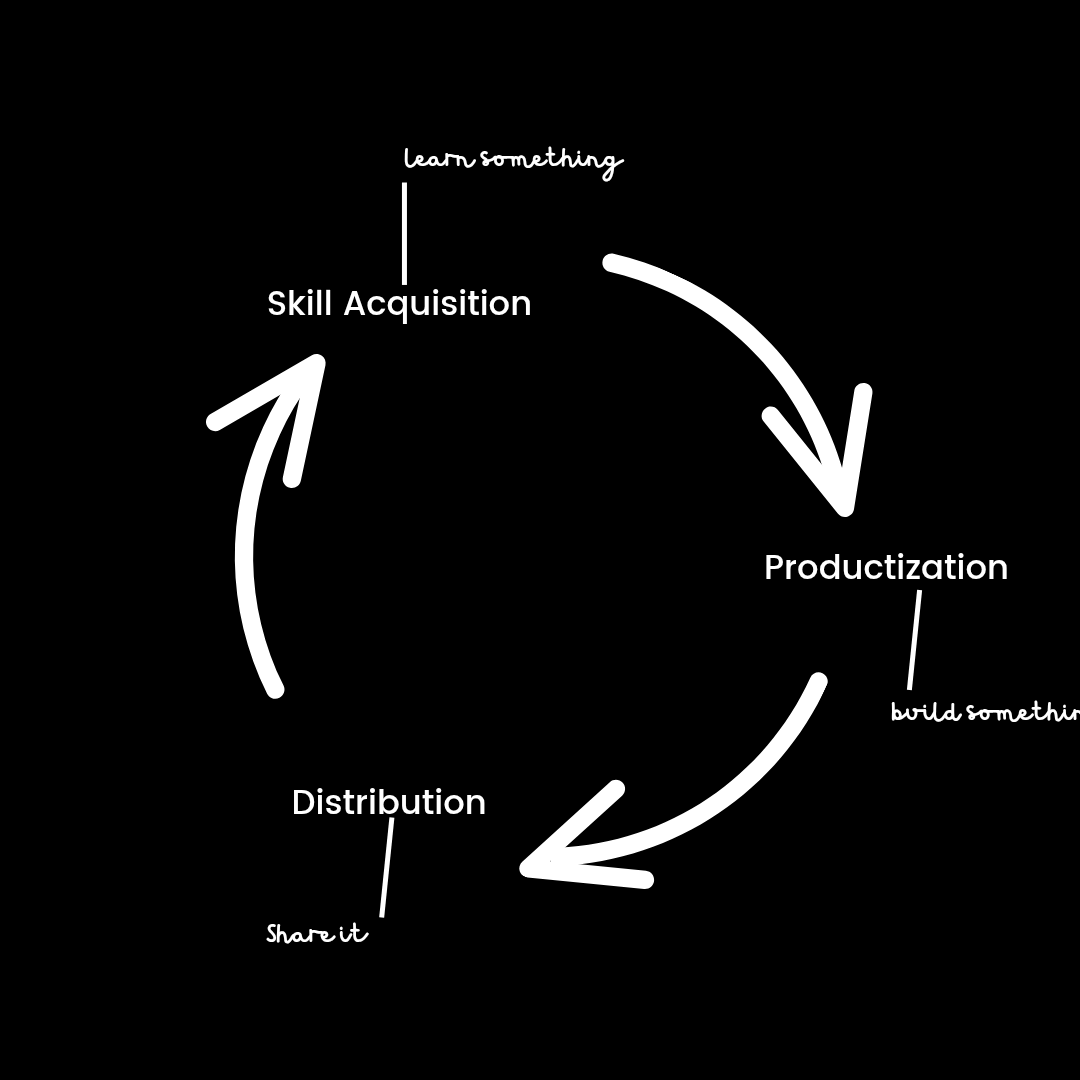
When you learn how to create and distribute value as a one-person business, you’re no longer just renting out your time. You’re building a system that gives you control over your income.
How To Build the Value Cycle
Most people never break free from the chain of chasing money because they lack a system of creating and multiplying money. They wait for opportunities instead of creating them. But if you approach value creation and making money like a game, the process becomes frictionless.
Here’s how to start:
1. Choose A Skill That Compounds
Pick a skill that scales with practice and leverage:
- writing,
- coding,
- design,
- marketing.
Learn a stack of the future-proof skills.
These aren’t just skills — they’re multipliers.
The more you practice, the more ways they can be packaged into services, content, or products.
“Play long-term games with long-term people.” — Naval Ravikant
2. Package Your Knowledge
Don’t let your skill sit idle. Package it into something tangible.
If you’re learning design, start offering freelance gigs or create design templates.
If you’re learning writing, package it into newsletters, ghostwriting, or micro-products.
3. Build A Distribution Channel
Your skill is useless if no one knows about it.
Start sharing what you learn online — posts, threads, short videos, newsletters.
Pick one platform to start. Distribution is leverage. Without it, your value stays hidden.
4. Run Small Experiments (MVP's)
MVP = minimum viable product.
Social media, in my eyes, is a testing ground for ideas that can be distributed to higher leverage platforms.
Post on social media. Start with writing.
Turn your best posts into threads and newsletters.
Turn your best threads and newsletters into free downloads.
Turn free downloads into an information product or service.
Turn your information product or service into a software, physical product, book, or other scalable business.
Every offer you create should act as a test. Test the market if your idea is viable before investing heavily in it
Treat freelancing, digital products, or coaching as experiments.
Each test teaches you what the market wants. Each success is a “level up.”
Treat the ideas that flop as just feedback for the next experiment. Iterate with feedback until your idea is ripe for the market.
5. Scale the Cycle
Reinvest what you learn into bigger opportunities.
Content → Freelancing → Productized service → Digital product → Startup.
Each stage builds independence and compounds your income control.
The difference between where you are and where you want to be isn’t luck or timing. It’s skill.
You aren’t where you want to be because you aren’t yet the person who belongs there. And the fastest way to change who you are is to acquire the skill that lets you take on bigger challenges — mental, physical, and financial.
“The best investment you can make is in yourself.” — Warren Buffett
That’s the work. That’s the game. And when you master the Value Cycle, you stop waiting for permission and start building freedom.
Thanks for reading.
-Patrick